
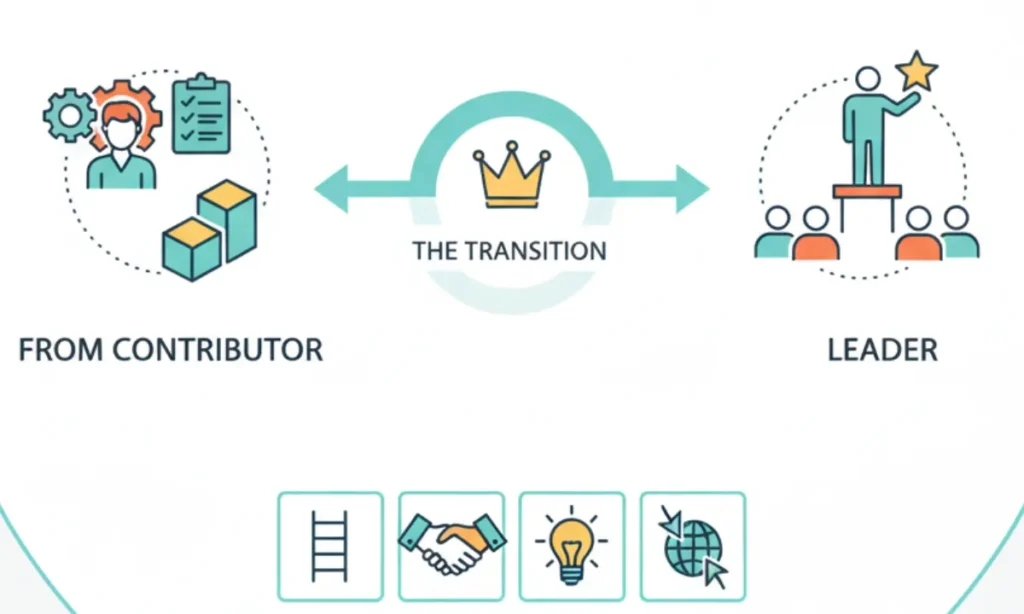
The individual contributor to leadership position is one of the biggest career moves you will ever undertake. What used to make you successful—doing things effectively and giving quality work—is now only a part of your new duties. But now you are responsible to lead others, make strategic choices, and work in the complicated organizational dynamics that are way beyond your former scope.
This shift is a challenge to even the most successful professionals. The qualities that made you get a promotion do not necessarily translate to being a good leader. While technical skills remain valuable, you should now enhance them with people management skills, strategic thinking, and political awareness to exert influence within your organization.
The issue is that many new leaders don’t realize that different team members need different styles of leadership. They want to be led the way they were, but they don’t understand that other team members need different styles of leadership. Some people are overwhelmed by how their own productivity affects the success of others. The best transitions happen when professionals take the lead in developing the skills, mindset, and relationships they need for their new role.
Shifting Your Mindset from Doer to Enabler
The basic issue of leadership transition is to redefine your value creation process. Personal output and expertise were the criteria of your value as an individual contributor. As a leader, you have to be successful based on the overall performance of your team and the capacity to multiply the capabilities of others.
This change necessitates a loosening of grip on day-to-day implementation and keeping results accountable. Instead of doing everything by yourself, you should be able to delegate efficiently, give instructions, and eliminate the barriers that do not allow your team to perform. This shift does not mean being disconnected from the work; rather, it involves engaging at a new level that focuses on strategy, coordination, and development instead of direct implementation.
Starting to view problems in a systems perspective rather than tackling problems at hand. Consider how the choices of different stakeholders will impact them, how the processes can be more efficient, and how the work of your team is connected to the overall organizational objectives. The bigger picture can help you to give priority to the activities that cause the greatest impact and place your team in a long-term winning position.
Accept the fact that your success today is based on building others and not only doing a great job yourself. Take time to learn the strengths of every team member, areas of growth, and career goals. Seek ways of challenging them and experience them in a way that builds their professional growth.
Building Credibility with Your New Team
It is a fine line between proving your ability and not undermining what your team already knows and understands, or risking breaking the relationships that they have had together. Your technical skills may have earned you the promotion, but your leadership will depend on your ability to gain the trust of your new team.
Start listening more than talking in the first few weeks in the position. Arrange individual meetings with team members and ask them about their ideas of the existing issues, ways to improve them, and what their personal aims are. Such discussions offer great information and also show that you appreciate their contribution and experience.
Do not rush to make any changes to the existing processes or team dynamics unless an urgent issue needs to be addressed. Before making changes, take time to know the reason why the current methods are in place and how well they have worked before making suggestions. This practice of the patient is respectful of your predecessor and is not going to cause you to unknowingly interrupt effective systems.
To demonstrate that you believe in the success of the team, support and advocate for it on a regular basis. Labor to ensure that the team members are provided with what they need, either in terms of resources, training, or organizational support. This is to ensure that the team and the organization in general should notice their efforts when they do well.
Share your learning process as well as be ready to tell what you are not aware of at any given point in time. Telling the truth and saying that you do not know but you are willing to find the answer establishes a feeling of trust and preconditions the atmosphere of constant learning that you want to be a part of your team.
Developing Essential Leadership Skills
The skills of an effective leader are way beyond technical abilities. Communication skills also take center stage, as you need to be very articulate in giving vision, feedback, and discussion facilitation and represent your team interest in front of other organizational leaders.
Understanding how to delegate the tasks to the team members based on their strengths and development goals will help one learn how to delegate effectively. Delegation does not just involve giving work; it involves putting the work into perspective by clarifying the significance of the task to be performed, laying expectations and due dates, and providing the support required without interfering in the working process.
Become a better coach to help the team members in their performance and career development. This is by applying thought-provoking questions that help people to seek answers rather than providing answers. The regular coaching talks allow addressing the problems beforehand and highlighting the development and the achievements.
Understand how to give feedback that is specific and practical as well as behavior-focused and not personality-focused. Positive recognition and positive feedback work better when they are timely, detailed, and connected with concrete examples to illustrate your points in a clear and exact way.
Work on your strategic thinking ability by setting aside some time to reason how the contribution of your team can be associated with the overall organizational objectives. Keep track of the industry trends, activities of the rivals, internal priorities, which can affect the focus of your team or resource distribution.
Navigating Organizational Politics as a Leader
The leadership position is bound to be more exposed to organizational politics and intricate relationships with stakeholders. The political awareness skills that were mentioned in the basics of office politics are even more critical when you have to represent the interests of your team and find resources that can help you achieve success.
As a leader, you have to be familiar with formal and informal power structures that impact decisions that impact your team. This involves knowing important stakeholders that you need to be supported by, the priorities and concerns of those stakeholders, and relationships that make work across organizational boundaries fruitful.
Master influencing without power by forming alliances on the basis of common goals. Your goals will involve many others in different departments with whom you are not related and whose cooperation you will need. The key to success lies in your capacity to make requests in the context of win-win and organizational value as opposed to the requirements of your team.
Be more strategic in dealing with up by updating your supervisor on the progress, problems, and resources of your team. Give frequent reports that show how your team is doing in meeting organizational goals as well as taking the initiative to resolve any problems before they develop into big problems.
Diplomatic communication should be practiced when there is a dispute between your team and other departments. Your agenda will be to safeguard the interests of your team and ensure that you have a healthy relationship that would facilitate the long-term cooperation and organizational performance.
Managing Former Peers and Senior Team Members
Managing relations with former colleagues who now report to you, or with team members who are more experienced or senior than you, is one of the most sensitive issues of leadership transition. Such cases must be handled with care in order to keep the respect and at the same time instill the right authority.
With previous peers, accept the change of the relationship openly and talk about the way you will cooperate in the future. Make it clear what you are going to do new and insist on your respect of their contribution and expertise. Pay attention to the way the new structure can contribute to the individual and team success.
In leading more experienced members of the team, use their knowledge and make your mark in driving the direction and making final decisions. Demonstrate that you respect their experience by asking them to contribute to making key decisions and providing them with a chance to mentor other colleagues or lead certain projects.
Flatten out any form of resistance or skepticism in a non-hostile yet diplomatic manner. Not all the team members might be on board with you or even believe that you are qualified. Manage such instances by concentrating on common goals, showing how you are interested in fair play and team performance, and by always keeping a promise you make.
Establish clear goals regarding communication, decision-making, and team dynamics, and also be amenable to feedback regarding ways of improving these. The fact that you were ready to change your strategy with the feedback indicates leadership maturity and contributes to creating buy-in in the required changes.
Creating Your Leadership Success Plan
The shift between contributor and leader is successful when you take it strategically with purpose, constant activity, and periodic review of your progress and what you still need to improve.
Start by identifying the top leadership competencies that will most probably make you successful in your new job and organization. They can be strategic planning, team building, stakeholder management, or change leadership, depending on your situation and organizational needs.
Identify great leaders in your organization who can guide you and offer feedback and insights into how to handle the usual leadership pitfalls. These networks are useful in terms of perspective and encouragement throughout your transition stage.
invest in formal leadership development by means of training programs, workshops, or executive coaching that can speed up your skill growth and equip you with structures for how to deal with complex leadership situations.
Establish a system of peer relations with other leaders of your level having the same challenges and opportunities. These links offer each other support, best practices, and collaboration opportunities, which are beneficial to your professional development and organizational performance.
Making the shift between the role of a contributor and the role of a leader is a major career milestone that introduces a possibility of making a difference and professional satisfaction. To become successful, one has to be willing to put in effort to acquire new competencies and retain the competence and integrity that made you get a promotion. Being strategic and working hard will help you to handle this transition and lay the groundwork of your future leadership success in your career.